
Electric Geyser vs Gas Geyser: Which Is Better This Winter?
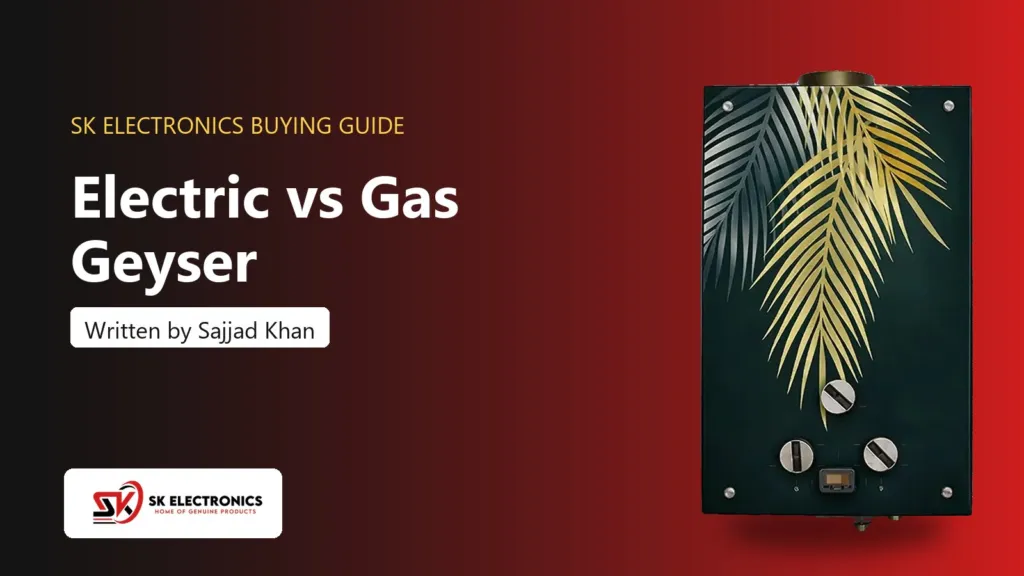
Quick answer: An electric geyser gives hot water whenever there is electricity and burns no gas, but a 3,000 W element uses 3 units for every hour it heats. Warming 60 litres of water by 30°C takes about 2.1 units. A gas geyser adds nothing to your electricity bill, but this winter SNGPL supplies domestic gas in Khyber Pakhtunkhwa, Punjab and Islamabad only at three cooking times a day. If gas reaches you when you need hot water, gas makes sense; if not, an electric or a dual gas and electric geyser is the reliable choice.
How does each type heat water?
- Electric storage geyser: an element heats a tank of water and a thermostat switches it off when the water is hot. The tank keeps water hot for later, so it needs good insulation.
- Gas instant geyser: a burner heats water only while it flows through, so there is no tank to keep hot. Our Nasgas instant models are rated at 6 and 7 litres per minute and run on LPG or natural gas.
- Gas storage geyser: a burner heats a tank, like the electric type but on gas.
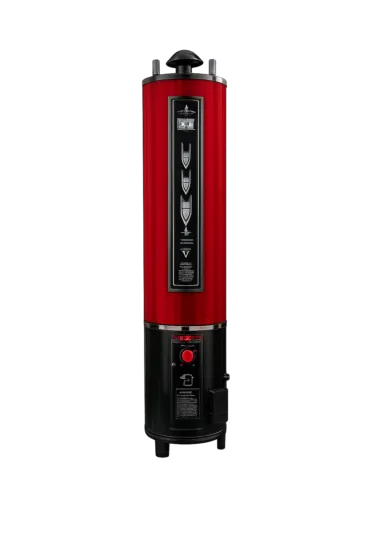
- Dual (gas and electric) storage geyser: a tank with both a burner and an element, so you can heat on whichever is available. The Nasgas DEG-35 GL Auto Super Deluxe is listed as an electric and gas storage water heater with a 3.0 kW element.
For a full comparison of instant and tank types on gas, read instant geyser vs storage geyser.
How many units does an electric geyser use?
An element’s rating tells you its units per hour: a 3,000 W (3 kW) element uses 3 units for each hour it is switched on. It is on only while it is heating, so what matters is how much hot water you use and how much you warm it.
Heating water takes a fixed amount of energy. Water’s specific heat is 4.184 joules per gram per °C, so heating one litre by 1°C takes about 4.2 kJ. That gives a simple formula:
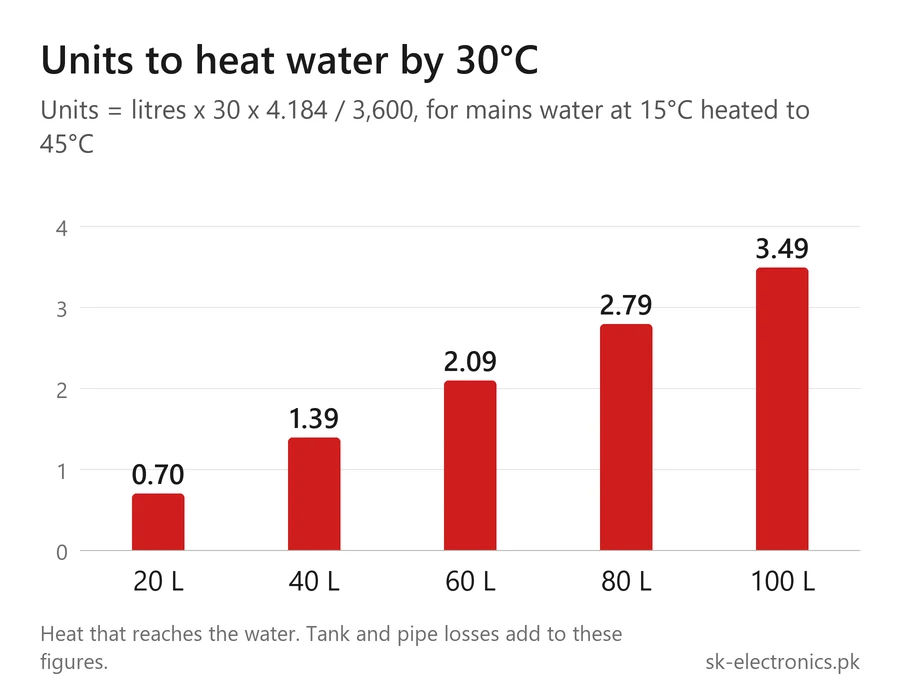
Units = litres x temperature rise (°C) x 4.184 / 3,600
| Hot water used | Units to warm it by 30°C | Time for a 3 kW element |
|---|---|---|
| 20 litres | 0.70 | About 14 minutes |
| 40 litres | 1.39 | About 28 minutes |
| 60 litres | 2.09 | About 42 minutes |
| 80 litres | 2.79 | About 56 minutes |
| 100 litres | 3.49 | About 70 minutes |
A 30°C rise takes mains water at 15°C up to 45°C. These figures are the heat that reaches the water; a storage tank also loses some heat through its walls and the pipes, which adds to the units. Better insulation and a lower thermostat setting reduce that loss.
Worked example for a family: four people each using 40 litres of hot water a day at a 30°C rise need 160 litres, or about 5.6 units a day. Over 30 days that is roughly 167 units, plus tank losses. Multiply by the per-unit rate on your own bill, and remember that residential tariffs are charged in slabs, so these units can also push the whole bill into a higher slab.
Why are instant geysers gas, not electric?
Because instant heating needs a lot of power at once. Warming water flowing at 6 litres a minute by 25°C takes about 10.5 kW, and at 7 litres a minute about 12.2 kW. A gas burner delivers that easily; a 3 kW electric element cannot. An electric geyser therefore stores water and heats it slowly in advance.
Gas supply this winter
From 4 November 2026, SNGPL limited domestic gas in Islamabad, Punjab and Khyber Pakhtunkhwa to three cooking-time slots: 6:30 to 9:00 am, 12:00 to 2:30 pm and 6:00 to 9:00 pm. That has two effects on geysers:
- An instant gas geyser gives hot water only during those slots.
- A gas storage or dual geyser can heat its tank during the slots and keep the water hot for a while afterwards, and a dual model can switch to its element when gas is off.
Electric vs gas geyser: side by side
| Electric storage | Gas instant | Dual gas and electric | |
|---|---|---|---|
| Running cost shows on | Electricity bill | Gas bill or LPG | Either, as you choose |
| Works when gas is off | Yes | No | Yes, on electricity |
| Works in load shedding | Tank stays hot for a while | Yes, if gas pressure is there | Yes, on gas when supplied |
| Hot water ready | After the tank heats | At once, while water flows | After the tank heats |
| Flame and carbon monoxide | None | Burns gas: needs a flue and ventilation | Burns gas when on gas |
| Our models | Nasgas DEG-35 on its element | Nasgas DG-06L (6 L/min), DG-7L (7 L/min) | Nasgas DEG-35 |
| Price (13 Nov 2026) | Rs 49,999 | Rs 19,999 and Rs 19,499 | Rs 49,999 |
Prices change with the market. Call 0333-9080484 or WhatsApp 0348-7647331 to confirm today’s price and stock.
Which is safer?
An electric geyser has no flame, so it gives off no carbon monoxide. It must still be wired with the right cable and earthing by an electrician, and its safety valve must work; the Nasgas DEG-35 lists a brass safety valve rated at 75 PSI and a dual safety thermostat.
A gas geyser burns fuel. The US CDC warns that carbon monoxide can cause sudden illness and death, and you cannot see or smell it. Install a gas geyser outside the bathroom with a flue to the open air, never in a closed space. Our gas geyser safety guide lists the installation rules and what to do if you smell gas.
Which geyser should you choose?
- Gas reaches you at the times you bathe: an instant gas geyser is the cheapest to buy and wastes no gas when nobody uses hot water.
- Gas comes only at cooking times, or not at all: an electric storage geyser, or a dual gas and electric model that heats on gas during the supply slots and on electricity when gas is off.
- Several bathrooms at once: a storage tank, because it can feed more than one tap at a time.
- Bills matter most: work out your daily hot water with the table above and compare it with your gas and electricity rates before you decide.
Ways to cut your geyser bill
- Set the thermostat no higher than you need. The units grow with every degree of temperature rise.
- Heat the tank before you need it, and switch the element off when the water is hot if your geyser has no automatic thermostat control.
- Insulate exposed hot water pipes, especially on roofs and outside walls.
- Take shorter showers. Halving the hot water halves the units.
- Fix dripping hot taps. Each litre lost was heated for nothing.
Frequently asked questions
How many units does a 3000 watt geyser use per hour?
3 units for each hour the element is on. The thermostat switches it off when the water is hot, so daily use depends on how much hot water you draw.
How many units does an electric geyser use in a month?
A family using 160 litres of hot water a day, warmed by 30°C, needs about 5.6 units a day, or roughly 167 units a month, plus heat lost from the tank and pipes.
Which is better, an electric geyser or a gas geyser?
Gas suits homes where gas is available when you need hot water. Electric, or a dual gas and electric model, suits homes where gas is limited, as it is this winter under SNGPL’s three-slot schedule.
Is an electric geyser safer than a gas geyser?
It has no flame and no carbon monoxide. It still needs correct wiring, earthing and a working safety valve, fitted by an electrician.
What is a dual gas and electric geyser?
A storage geyser that can heat its tank on gas or on an electric element. The Nasgas DEG-35 is one, with a 3.0 kW element.
Next steps
See all models in our geyser range. For the full picture of winter bills, read AC heat mode in winter and our appliance power consumption chart.
Sources
- OpenStax Chemistry 2e, Appendix E: Water Properties (specific heat 4.184 J/g°C): openstax.org
- ProPakistani, SNGPL announces winter gas supply timings for Islamabad, Punjab and KP (4 November 2026): propakistani.pk
- US Centers for Disease Control and Prevention, Carbon Monoxide Poisoning Basics: cdc.gov/carbon-monoxide/about
- Product specifications: Nasgas DEG-35, DG-06L and DG-7L product pages on this site.