
1.5 Ton Inverter AC Units per Hour: Real Figures and Bill Examples
Quick answer: A 1.5 ton inverter AC uses between about 0.3 and 1.9 units of electricity per hour. It draws the most, around 1.6 to 1.9 units an hour, while it pulls a hot room down to the set temperature, then slows its compressor and can drop to about 0.3 units an hour while it holds that temperature. One unit on your bill is one kilowatt-hour (kWh), which is 1,000 watts used for one hour. The exact figure for your home depends on the heat outside, the room, the temperature you set and how many hours it runs.
What is “one unit” on the electricity bill?
The unit on your bill is a kilowatt-hour (kWh). An appliance that draws 1,000 watts for one hour uses 1 unit. One that draws 500 watts for two hours also uses 1 unit. So:
Units = watts / 1,000 x hours
To work out the units an AC uses, you need its power input in watts. Good spec sheets give a range, not one number, because an inverter AC does not run at a fixed power.
Real figures from the inverter ACs we sell
These figures come from the manufacturers’ specifications on our product pages. “Min” is the lowest power the compressor runs at, “rated” is the power at the standard test point, and “max” is full power.
| Model (1.5 ton) | Cooling power input | Units per hour |
|---|---|---|
| Gree GS-18PITH11W Pular | 320 W min, 1,600 W rated, 1,900 W max | 0.32 to 1.9 (1.6 rated) |
| Super General SGS-181-PK | about 320 W to 1,682 W, depending on mode | about 0.32 to 1.7 |
| PEL Turbo DC Ultimate T3 PINV-18K | cooling current 1.9 to 8.3 A, 6.8 A rated | up to about 0.4 to 1.9 (our estimate: current x 230 V, which gives an upper figure) |
The Kenwood E-Serene and Orient Smartron Pro product pages do not list a power input, so ask the branch for their spec sheet if you want to compare them the same way.
Why an inverter AC does not use a fixed number of units
A normal AC runs its compressor at full power until the room is cool, then switches off, then starts again at full power. An inverter AC changes the compressor speed instead. ENERGY STAR describes variable speed compressors as the much more efficient option, which lets an air conditioner cool the room quietly and save a significant amount of energy.
That is why the same AC can use 1.9 units in the first hour of a hot afternoon and well under 1 unit an hour later at night. Our guide to inverter AC vs normal AC explains the difference in more detail.
Monthly bill examples: 8 hours a day for 30 days
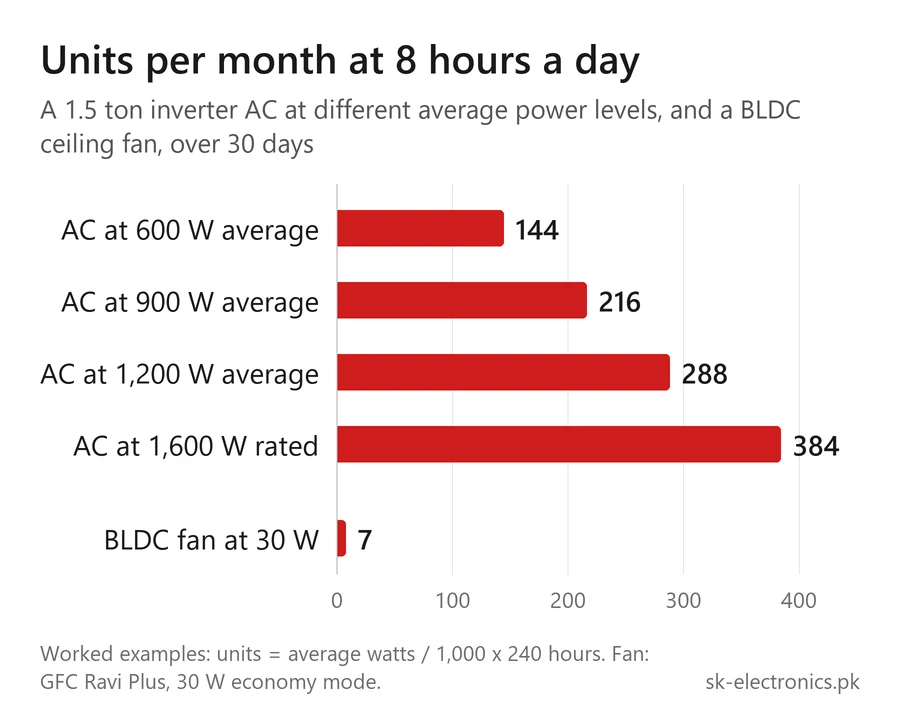
Because the hourly figure moves, the honest way to estimate a month is to pick an average. The table shows the units for 8 hours a day over 30 days (240 hours) at different average power levels within the range above:
| Average power over the night | Units per hour | Units per month (240 hours) |
|---|---|---|
| 600 W (mild weather, well-shaded room) | 0.6 | 144 |
| 900 W | 0.9 | 216 |
| 1,200 W (hot weather, sunny room) | 1.2 | 288 |
| 1,600 W (running at rated power the whole time) | 1.6 | 384 |
These are worked examples, not a promise of what your AC will use. To turn units into rupees, multiply by the per-unit rate printed on your own bill. Residential tariffs in Pakistan are charged in slabs, so the extra units an AC adds can also move the whole bill into a higher slab. Check the slab table on your bill.
How does that compare with a fan?
The GFC Ravi Plus BLDC fan we sell is rated at about 30 W in economy mode and about 45 W on turbo. Over the same 240 hours a month, that is about 7 to 11 units. Running a BLDC fan with the AC lets you set the AC a degree or two higher and still feel cool.
How many units does a heat and cool AC use in winter?
Several of our 1.5 ton models also heat. The Gree GS-18PITH11W lists a rated heating output of 5,300 W for a rated power input of 1,450 W. In plain terms, at its rated test point it delivers about 3.7 units of heat for each unit of electricity, so it uses about 1.45 units an hour at rated heating.
An electric rod heater turns one unit of electricity into one unit of heat. A 2,000 W heater uses 2 units an hour and delivers 2,000 W of heat. That is why a heat and cool inverter AC is a much cheaper way to heat a room with electricity. Rated figures are measured at standard test conditions; on very cold days the output is lower.
Seven ways to use fewer units
- Buy the right size. An undersized AC runs at full power for hours. Check your room with our AC size calculator and our guide to the right AC size for your room.
- Set it as high as is comfortable. ENERGY STAR suggests about 78°F, which is about 26°C.
- Keep heat away from the indoor unit. ENERGY STAR warns that lamps or TVs near the thermostat make the AC run longer.
- Seal the room. Close gaps around doors and windows. ENERGY STAR notes that a badly installed unit leaks as much air as a 6 square inch hole.
- Shade the windows that get afternoon sun.
- Clean the filters as the manual describes, and keep the outdoor unit clear.
- Use a fan with the AC so you can set the temperature higher.
Frequently asked questions
How many units does a 1.5 ton inverter AC use per hour?
Between about 0.3 and 1.9 units per hour. For example, the Gree GS-18PITH11W draws 320 W at minimum, 1,600 W rated and 1,900 W at maximum, which is 0.32 to 1.9 units per hour.
How many units does a 1.5 ton inverter AC use in a month?
At 8 hours a day for 30 days, about 144 units if it averages 600 W, about 216 units at 900 W and about 288 units at 1,200 W. Hot weather, a sunny room or a low temperature setting push it higher.
Does an inverter AC use fewer units than a normal AC?
Usually yes, because it slows down instead of switching on and off at full power. ENERGY STAR calls variable speed compressors the much more efficient option.
How many units does an AC use on heating in winter?
The Gree GS-18PITH11W lists 1,450 W input for 5,300 W of heat at its rated point, so about 1.45 units an hour. A 2,000 W rod heater uses 2 units an hour for less heat.
What temperature should I set to save electricity?
As high as is comfortable. ENERGY STAR suggests about 78°F, which is about 26°C. Using a fan as well helps you stay cool at that setting.
Next steps
Compare the power figures on our split AC range, or visit any of our four branches to ask for a spec sheet. If you are also choosing water heating for winter, read instant geyser vs storage geyser. For more help, see all our buying guides.
Also read: AC heat mode: units per hour in winter, which AC mode saves the most units.
Sources
- ENERGY STAR, Room Air Conditioners (variable speed compressors, thermostat setting, installation): energystar.gov/products/room_air_conditioners
- Product specifications: Gree GS-18PITH11W, Super General SGS-181-PK, PEL PINV-18K and GFC Ravi Plus product pages on this site.