
Automatic vs Semi-Automatic Washing Machine: Which to Buy
Quick answer: A fully automatic washing machine washes, rinses and spins without you moving the clothes between stages. A semi-automatic machine needs more of your attention. In a twin tub, you move the clothes from the wash tub to the spin tub yourself. ENERGY STAR says front-load washers use about 50 percent less energy and water than top-load agitator washers, and that heating the water takes about 90 percent of the energy a washer uses.
What “semi-automatic” means in our range
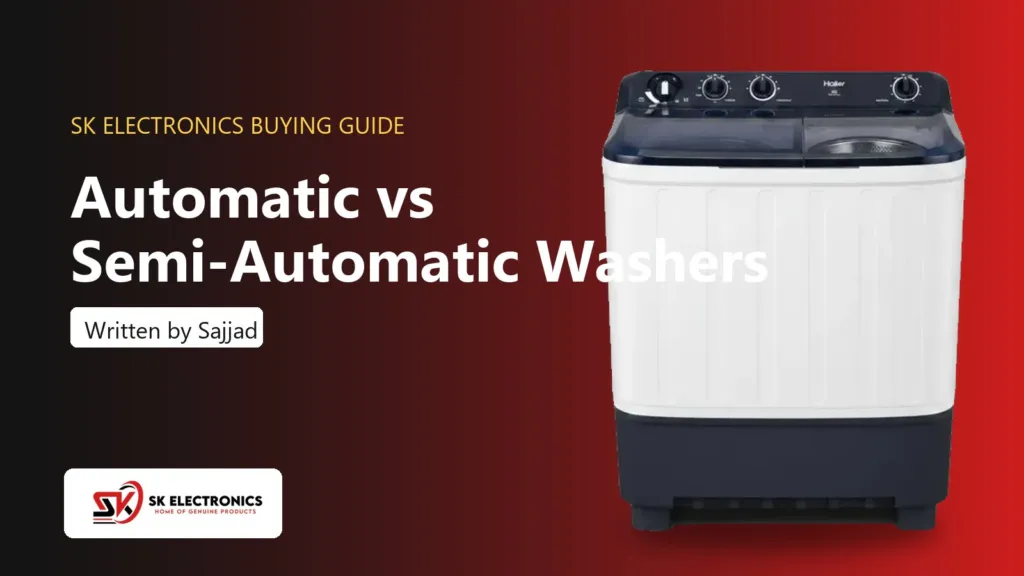
Several of our product pages use the term “semi-automatic”. The Haier HTW-100-1217W, for example, is a 10 kg twin tub machine with a separate wash tub and spin tub, so the clothes move between the two by hand. Other semi-automatic models in our range are single-tub or top-load machines, where you control each stage. Read the type line on each product page, because the term covers more than one design.
What “fully automatic” means
A fully automatic machine runs the wash, rinse and spin cycles itself after you choose a programme. Our fully automatic models include top-load machines such as the Haier 85-826 (8.5 kg) and the Dawlance DWT-11671 FLT (11 kg), and front-load machines such as the Haier HW80-BP12929S6 (8 kg) and the TCL C2110FLG (10 kg).
Comparison of the main types
| Point | Semi-automatic twin tub | Semi-automatic single tub or top load | Fully automatic top load | Fully automatic front load |
|---|---|---|---|---|
| What you do | Move clothes between the wash and spin tubs | Control each stage | Choose a programme and load | Choose a programme and load |
| Examples in our range | Haier HTW-100-1217W (10 kg), Haier HWM-100 (10 kg), PEL PWM-1050T | GFC GF-888 (10 kg), Haier HWM 120-35FF (12 kg), PEL PWMS-1250T (12.5 kg), Super Asia SA-255 (8 kg) | Haier 85-826 (8.5 kg), Dawlance DWT-11671 FLT (11 kg) | Haier HW80-BP12929S6 (8 kg), Dawlance 8120 (8 kg), Samsung WD85T4046CE (8.5 kg), TCL C2110FLG (10 kg) |
| Energy and water | Not compared in the ENERGY STAR statements used here | Not compared in the ENERGY STAR statements used here | Agitator top loaders use more energy and water than front loaders, according to ENERGY STAR | About 50 percent less energy and water than a top-load agitator washer, according to ENERGY STAR |
| Floor and space | Check the dimensions on the product page | Check the dimensions on the product page | Needs space above for the lid to open | Needs space in front for the door to open |
Energy and water: why the type matters
ENERGY STAR states that certified front-load washers use about 50 percent less energy and water than a top-load agitator washer. It also states that heating the water consumes about 90 percent of the energy a washer uses. Less water per load means less water to heat, so the front-load advantage comes partly from heating.
The ENERGY STAR comparison is between front-load and top-load agitator machines. It does not rate the semi-automatic twin tub machines in our range, so compare their capacity and specification on the product pages instead of assuming a saving.
How to choose between them
Choose a twin tub if
You want a simple machine, you do not mind moving the clothes between the tubs, and the household’s laundry fits the capacity. Check the wash capacity in kilograms on the product page, and choose the size that matches your usual load.
Choose a fully automatic top load if
You want to load the machine and start a programme, and you have room above it for the lid to open.
Choose a fully automatic front load if
Energy and water use matter most to you, and you have room in front for the door to open. ENERGY STAR’s figures favour front loaders, so this is the type to compare if running costs are your priority.
Practical checks before you buy
- Check the water supply and power point at home, and make sure there is a drain or a place for the outlet hose.
- Measure the space, including the door swing for front-load models and the lid clearance for top-load models.
- Choose the capacity from the household’s usual load, not only from the largest number on the page.
- Ask the branch who handles service in your area, and keep the warranty card with the receipt.
Save energy on every wash
ENERGY STAR advises washing in cold water. It notes that heating the water takes most of the energy, and that washing in cold water will generally do a good job unless you are dealing with oily stains. This applies to every type of machine in this guide.
Choosing the capacity
Capacity is the weight of laundry the machine takes in one load, shown in kilograms on the product page. Choose the figure that matches your usual load. Buying the largest capacity for the occasional large wash means paying for space you rarely use. Buying too small means extra loads every week.
Think about a normal week. Count the loads, note whether the family needs bedding or school uniforms washed separately, and choose a capacity that handles the heaviest regular load without strain.
Water supply and drainage
Every washing machine needs a water inlet and a drain. Check that the tap is close enough for the inlet hose, and that the drain hose can reach a sink or outlet at a suitable height. Ask the branch to explain the hose lengths for the model you choose. Manual water inlets, which some of our semi-automatic models use, need you to fill the machine yourself.
Space and access
Measure the place where the machine will stand. A front-load machine needs room in front for the door to open fully, and a top-load machine needs room above for the lid. Check that you can reach the controls and the drain without moving furniture.
Common mistakes
- Choosing by the number on the box alone. Look at the type and the kilogram figure together.
- Forgetting the door swing. A front-load door that cannot open fully makes loading and unloading hard.
- Ignoring the water and drain points. Check them before delivery, not after.
- Using hot water by default. ENERGY STAR advises cold water for most loads, because heating water takes most of the energy.
Looking after the machine
Follow the manual for cleaning and maintenance. Leave the door or lid open between washes so the inside can dry, and avoid overloading the drum. Keep the warranty card with the receipt, and ask the branch who handles service in your area.
Frequently asked questions
Is a front-load washer better than a top-load washer?
ENERGY STAR states that front-load washers use about 50 percent less energy and water than top-load agitator washers. Whether that matters to you depends on your running costs and your space.
Is a twin tub machine suitable for a large family?
It can be, if the wash capacity matches your usual load. Compare the kilogram figure on each product page, and ask the branch to show you the machine in use.
Can I wash in cold water with any machine?
ENERGY STAR advises cold water for most loads, because heating the water uses most of the energy. The advice makes an exception for oily stains.
Which type is the simplest to use?
A fully automatic top-load machine is the simplest to use, because you choose a programme and load it. A twin tub needs you to move the clothes between tubs.
Next steps
Browse our washing machine range and compare the capacity and type on each product page. Our branches can show you the machines before you decide. For other appliances, see all our buying guides.
Sources
- ENERGY STAR, Clothes Washers (front-load and top-load energy and water comparison, water heating share, cold water advice): energystar.gov/products/appliances/clothes_washers