
Can an Inverter AC Run on Solar Panels?
Quick answer: Yes, a DC inverter AC runs well on solar, because it slows its compressor down once the room is cool instead of switching on and off at full power. A 1.5 ton inverter AC draws roughly 0.3 to 1.9 kW. Running one for 8 daytime hours at an average of 1 kW needs about 8 kWh a day, which takes roughly 1.8 kW of panels at Pakistan’s average solar output of about 4.5 kWh per kW of panels per day, before your other loads and system losses. Without a battery, it runs only while the sun is strong enough, unless your system can draw the shortfall from the grid.
Why an inverter AC suits solar
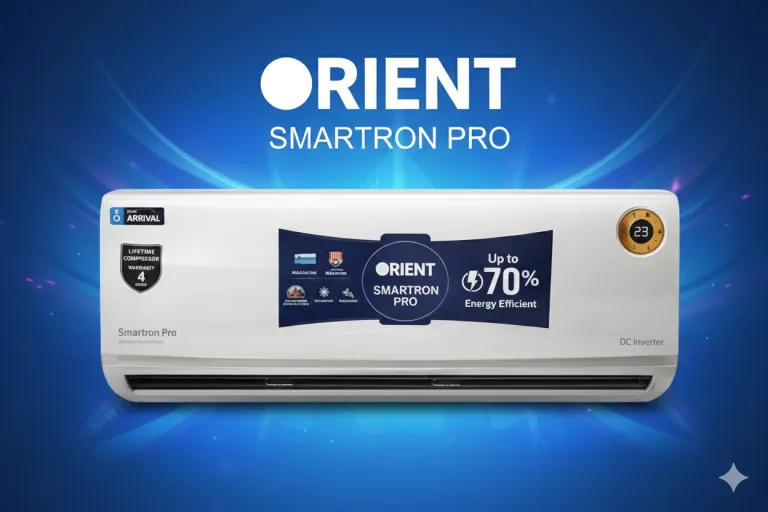
A normal AC starts its compressor at full power again and again. An inverter AC changes compressor speed to match the room, which ENERGY STAR describes as the much more efficient option. On solar, that steadier, lower draw fits the power your panels produce through the day. Some makers say so directly: the Orient Smartron Pro is listed as solar compatible.
How much power does a 1.5 ton inverter AC need?
| Model | Cooling power input |
|---|---|
| Gree GS-18PITH11W | 320 W minimum, 1,600 W rated, 1,900 W maximum |
| Super General SGS-181-PK | about 320 W to 1,682 W |
The AC draws the most while it pulls a hot room down, then much less while it holds the temperature. See how many units a 1.5 ton inverter AC uses per hour for monthly examples.
How many solar panels for a 1.5 ton inverter AC?
Work it out from energy first, then check the power at midday.
- Energy per day. If the AC runs 8 daytime hours at an average of 1,000 W, it uses 8 kWh (8 units) a day.
- Solar output per kW of panels. The World Bank’s Global Photovoltaic Power Potential report places Pakistan among the countries where the long-term daily average exceeds 4.5 kWh for each kW of panels. Winter, haze and dust lower it on many days.
- Panels for the AC alone. 8 kWh divided by 4.5 kWh per kW is about 1.8 kW of panels, just for the AC, on an average day.
- Add the rest of the house and losses. Fans, the fridge and lights also need power, and inverters and wiring lose some energy. Your installer adds these on top.
| AC average power, 8 daytime hours | Energy per day | Panels needed at 4.5 kWh per kW per day |
|---|---|---|
| 600 W | 4.8 kWh | about 1.1 kW |
| 1,000 W | 8 kWh | about 1.8 kW |
| 1,400 W | 11.2 kWh | about 2.5 kW |
These are worked examples for the AC alone, not a system design. Panels give their full rating only in strong sun around midday, so mornings, late afternoons and cloudy days produce less. Ask a solar installer to size the full system for your home.
Can you run an AC on solar without a battery?
It depends on your solar inverter:
- On-grid or hybrid system: the AC runs on solar first and takes any shortfall from the grid, so it keeps running when a cloud passes. Without a battery, it falls back fully on the grid at night.
- Off-grid system without a battery: the AC runs only while the panels produce enough power. When clouds pass or the sun drops, it can stop.
Either way, an inverter AC is the better match, because it can run at lower power when solar output is weak.
Tips for running an AC on solar
- Cool the room in the middle of the day, when panels produce the most, and keep doors and curtains closed so it holds the cool into the evening.
- Set about 26°C. ENERGY STAR suggests setting the thermostat as high as is comfortable, typically 78°F, which is about 26°C.
- Keep the filters and outdoor coil clean, so the AC does the job with less power.
- Choose the right size. An AC that is too small runs at full power all day; check with our AC size calculator.
Frequently asked questions
Can an inverter AC run on solar panels?
Yes. An inverter AC changes its compressor speed instead of switching on and off at full power, which suits solar well. Some models, such as the Orient Smartron Pro, are listed as solar compatible.
How many solar panels do I need for a 1.5 ton inverter AC?
For 8 daytime hours at an average of 1 kW, about 1.8 kW of panels for the AC alone, using the World Bank’s figure of more than 4.5 kWh per kW of panels per day for Pakistan. Add your other loads and system losses.
Can I run an AC on solar without a battery?
Yes, during the day. On an on-grid or hybrid system it takes any shortfall from the grid; on an off-grid system without a battery it can stop when solar output drops.
Can a normal (non-inverter) AC run on solar?
It can, but it starts at full power again and again, which needs a bigger solar system. An inverter AC is the better choice for solar.
How many units does a 1.5 ton inverter AC use on solar?
The AC uses the same units whether the power comes from solar or the grid: about 0.3 to 1.9 units per hour for a 1.5 ton inverter model. Solar simply supplies them.
Next steps
Compare solar-friendly DC inverter models in our split AC range and read our split AC buying guide. For the power use of the rest of your home, see our appliance power consumption chart.
Sources
- World Bank / ESMAP, Global Photovoltaic Power Potential by Country (June 2020): worldbank.org report (PDF)
- ENERGY STAR, Room Air Conditioners: energystar.gov/products/room_air_conditioners
- Product specifications: Gree GS-18PITH11W, Super General SGS-181-PK and Orient Smartron Pro product pages on this site.